Bringing a 1.56TB Frontier Model Down to Your Own Servers──What Kimi K3's Full Weight Release Reveals About the Cost and Fine Print of "Running It In-House"
The full weights of "Kimi K3," a largest-class open model with 2.8 trillion total parameters, were released on July 27. We lay out the reality of 1.56TB of actual data and a 64-accelerator-class cluster, the fine print of its custom license, and the one line that matters most for running it in-house

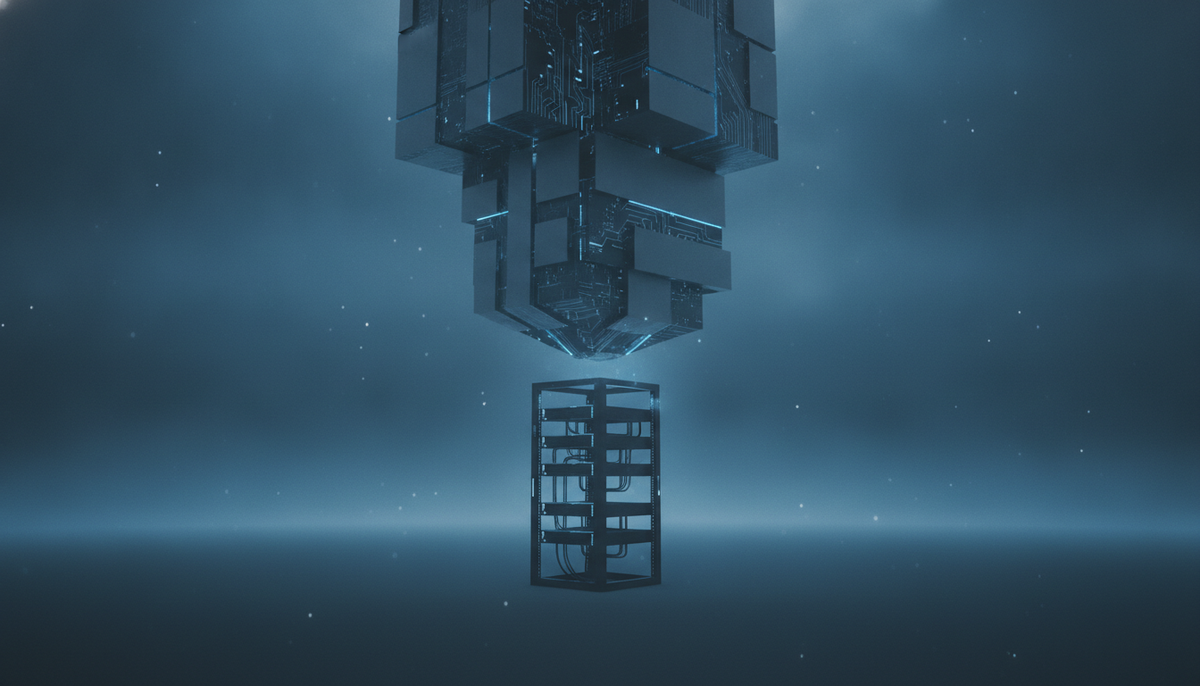
On July 27, Moonshot AI released the complete weights (the full set of parameters) for its large language model "Kimi K3." With 2.8 trillion total parameters, this "largest-class open model" can now not only be borrowed over an API but also downloaded and run in your own environment. That said, what "open" actually means here is a little different from simply being free for all. In this piece, we lay out the facts of the release and how it plays into running the model in-house.
The Day the "Promise" Became Real
The Kimi K3 model itself had already been announced in mid-July, but the weight release was scheduled for "July 27." True to that promise, the real thing was placed in the official Hugging Face repository (moonshotai/Kimi-K3) on that very day. By the numbers, the scale is heavyweight.
- Distribution format: shards in safetensors format, roughly 1.56TB for the entire repository (over 1.56 trillion bytes)
- Model architecture: Mixture-of-Experts (MoE), 2.8 trillion total parameters, 10.4 billion activated per token
- Context length: approximately 1,048,576 tokens (on the order of one million tokens)
- License designation: tagged with the generic "other" label on Hugging Face (i.e., a custom license)
For coding use cases, there is also "Kimi Code CLI"──a terminal-style agent that uses K3 (written in TypeScript, open source, with sub-agent support)──positioning the model and the agent as a pair to embed into development workflows.
The Fine Print of "Open"──The Three Lines Drawn by the Kimi K3 License
The released weights are not distributed under a standard license like MIT or Apache 2.0, but under a custom "Kimi K3 License." Downloading, self-hosting, fine-tuning, and quantization are permitted, while commercial "sub-leasing" comes with conditions. The three key points are as follows.
| Point | Details |
|---|---|
| Permitted uses | Downloading the weights, in-house self-hosting, fine-tuning, quantization |
| MaaS (inference resale) condition | An operator whose group revenue exceeds $20 million over any consecutive 12 months and who resells inference access externally must enter into a separate agreement with Moonshot |
| Attribution requirement | A commercial product with over 100 million monthly active users, or over $20 million in monthly revenue, is required to display "Kimi K3" prominently in its UI |
Put the other way around, purely internal use is said to fall outside the conditions above. As long as you run it for your own development and operations, you are not bound by the revenue triggers or attribution requirements──and this is the single line that matters most from an "use it in-house" standpoint. That said, since interpreting the license clauses depends on your own usage pattern, it is safest to run it by your legal team before putting it into production.
You Can Download It, but Running It Is Another Matter
"Getting hold of the weights" and "being able to run them locally" are not the same thing. A 2.8-trillion-parameter-class model demands substantial compute even after quantization. The reported rules of thumb are as follows.
- Even with MXFP4 quantization, resident memory is on the order of about 1.4TB
- For serving, Moonshot recommends a "supernode" configured with 64 or more accelerators (GPUs, etc.)
- This is not the kind of scale you routinely run on a single laptop or workstation
In other words, self-hosting is not so much a case of things being "opened up for free" as it is a new option to "take on the cost of your own cluster instead of borrowing." For reference, via the API, K3 is available at $3 per million input tokens ($0.30 when cached) and $15 per million output tokens, and for many teams this will remain the practical entry point for the time being.
Why Run It In-House Anyway
The motivation for choosing in-house hosting despite the high bar leans less on raw performance and more on "where the data gets processed." Send it to an API and your input passes through an external service; keep it closed within your own environment and you can run a frontier-class model without letting code or confidential material leave the company. For organizations that prioritize data residency and regulatory compliance, or teams that want to avoid sending data to overseas APIs, this is the biggest advantage. The fact that internal use falls outside the license conditions is another point in favor of going in-house.
Coding performance is not to be dismissed either. K3 is reported to rank near the top in the front-end code category of Arena.ai, and on some benchmarks such as Program Bench and SWE Marathon it is said to surpass earlier models. The very fact that development teams now have the option of a "practical-grade brain you can keep on your own premises" is a step forward for in-house, on-prem-minded teams.
Points to Weigh Before Getting Carried Away
On the other hand, it would be premature to conclude one-sidedly that "we can now do everything in-house." There are several points that deserve a cool-headed look.
- Operating cost: 1.56TB of weights and a 64-accelerator-class cluster mean neither the upfront investment nor the power and maintenance are light. The dynamic where cost bites harder the longer you keep it running is, in essence, no different from the API era.
- Misreading the license: even though it is "open," it is a custom license, and resale or large-scale consumer-facing use comes with conditions. Including the scope of internal use, you need to confirm the interpretation of the clauses yourself.
- The gap on the hardest tasks: on the most difficult challenges──such as FrontierSWE (K3 81.2 vs. Fable 5 86.6) or DeepSWE (K3 67.5 vs. GPT-5.6 Sol 73.0)──there remain areas where it does not reach the leading models. Assuming it can replace everything would be a misjudgment.
Even so, the significance of reaching a state where you can "bring the largest-class open model down onto your own servers, albeit with conditions," is not small. The realistic sense of running development without leaning entirely on a cloud API, and without letting data leave your walls, has moved up a notch──and that is the temperature at which it is reasonable to take this in.
References: moonshotai/Kimi-K3 (Hugging Face) / Kimi K3 Open Weights Shipped: What the Licence Says (Digital Applied) / Kimi K3: Open Frontier Intelligence at 2.8T Scale (Digital Applied) / Moonshot AI Releases Kimi Code CLI (MarkTechPost) / Kimi K3, and what we can still learn from the pelican benchmark (Simon Willison)